
Bitcoin mining explained — that’s the phrase I typed into Google at 1:17am three years ago after watching two YouTube videos and convincing myself I might accidentally become a tech millionaire.
Spoiler: I did not.
What I did do was nearly overheat my old gaming PC, spike my electricity bill, and have a very awkward conversation with my wife that started with:
“Why does it sound like there’s a jet engine in the office?”
So yeah. Let’s talk about this whole thing like normal humans.
Because when people first hear “Bitcoin mining,” they picture guys with pickaxes digging digital gold in a cave. Which honestly? Not the worst metaphor.
Wait. What Even Is Bitcoin Mining?
Okay.
First, there’s Bitcoin. Digital money. No banks. Just code and computers and a mysterious creator named Satoshi Nakamoto who basically dropped it into the world in 2009 and disappeared like a financial Batman.
Now here’s where mining comes in.
Bitcoin mining is the process that:
- Confirms transactions
- Secures the network
- Releases new bitcoins into circulation
It’s not digging.
It’s solving insanely complex math problems using powerful computers.
And when a computer solves one of these problems? Boom. Reward.
Bitcoin.
It’s like a lottery — but instead of buying tickets, you’re running hardware 24/7 and praying your machine guesses the right number first.
Kinda wild, right?
How Bitcoin Mining Works (Without Making You Regret Reading This)
Let me try to explain how Bitcoin mining works without sounding like I swallowed a textbook.
Imagine there’s a giant public spreadsheet. Every time someone sends Bitcoin, that transaction gets added to a “block.”
Miners compete to verify that block.
They do this by racing to solve a cryptographic puzzle.
Whoever solves it first:
- Gets to add the block to the blockchain
- Receives a reward (currently 3.125 BTC per block after the most recent halving — which is a whole other rabbit hole)
It’s basically competitive math.
With electricity.
Lots of electricity.
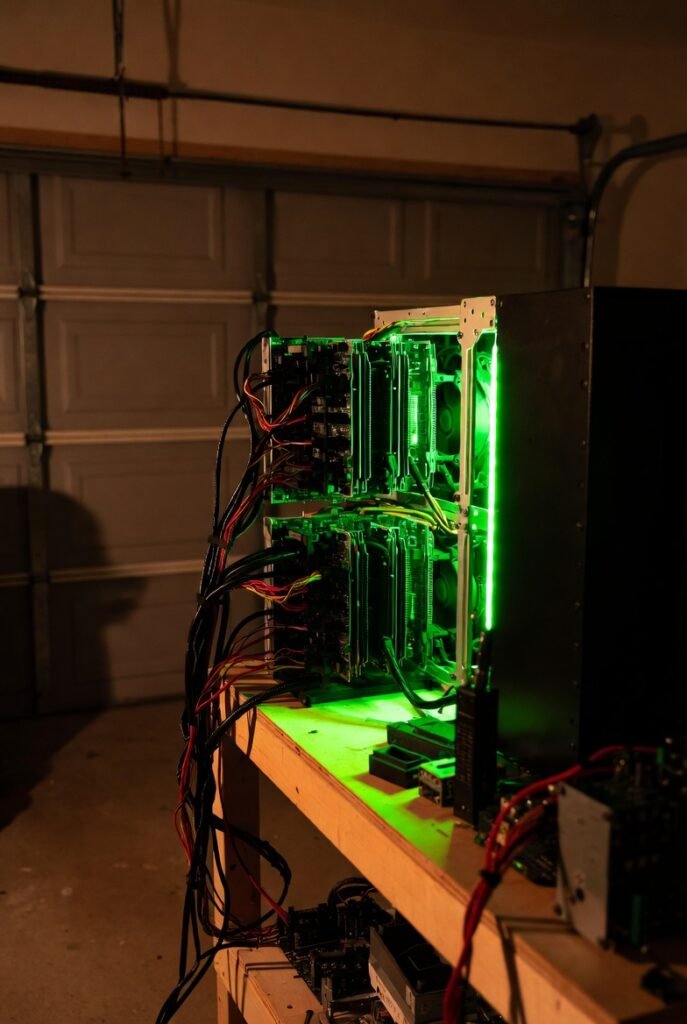
And specialized machines that look like something out of a sci-fi basement lab.
My First Attempt at Mining Bitcoin (AKA: The Humbling)
So here’s what I did.
I thought, “I’ve got a gaming PC. How hard could it be?”
I downloaded mining software.
Joined a mining pool.
Let it run overnight.
The next morning:
- My office was hot.
- My PC fan sounded like it was auditioning for Top Gun.
- I had earned approximately… $0.87.
For eight hours.
I just stared at the screen like, “Is this… normal?”
Turns out? Yes.
Mining Bitcoin at home with a regular computer isn’t really competitive anymore.
Back in 2010? Sure.
Now? Not so much.
It’s like showing up to a NASCAR race on a bicycle.
Technically allowed.
Emotionally devastating.
So What Hardware Do You Actually Need?
Here’s where crypto mining hardware comes in.
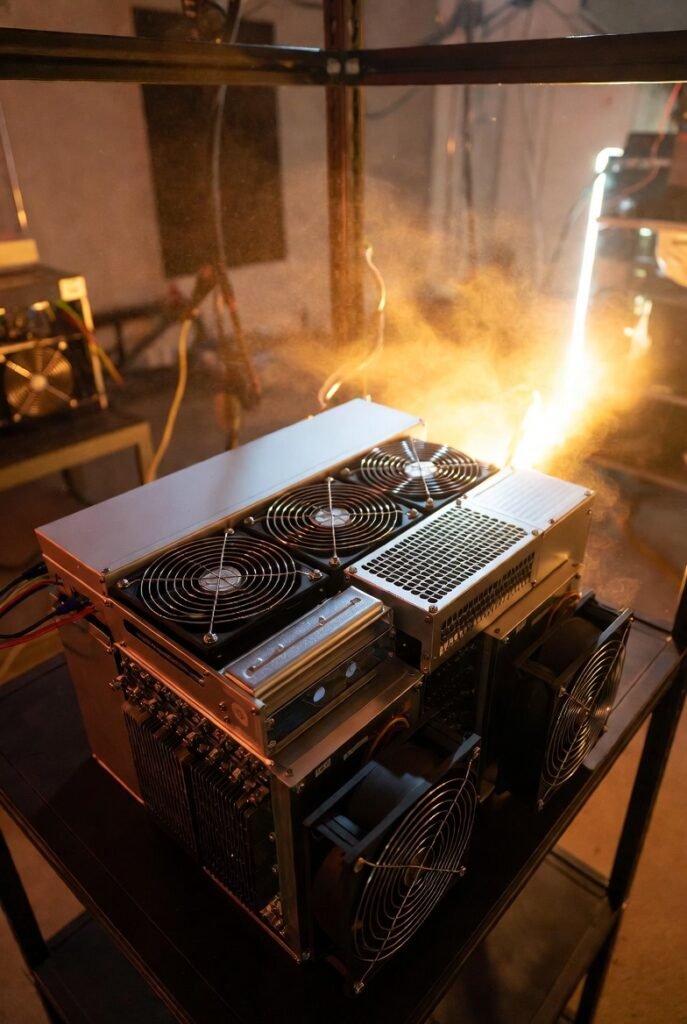
You can’t really use a basic laptop anymore. You need something called an ASIC (Application-Specific Integrated Circuit).
These machines are built specifically for mining Bitcoin.
They don’t browse the internet.
They don’t care about your emails.
That’s it.
Companies like Bitmain manufacture popular ASIC miners like the Antminer series.
They’re powerful.
They’re loud.
And they can cost thousands of dollars.
Which is when my enthusiasm cooled off just a bit.
What About Mining Pools?
Okay, so here’s something that actually makes sense.
Instead of mining solo (which is like buying one lottery ticket), you join a mining pool.
A mining pool is basically a group of miners who combine their computing power.
When the pool successfully mines a block, everyone gets a share of the reward based on how much computing power they contributed.
It’s teamwork.
Digital teamwork.
Less lonely. Slightly more predictable payouts.
Still not guaranteed riches.
But more realistic.
The Electricity Problem (Nobody Talks About This Enough)
Let’s be honest.
Bitcoin mining eats electricity like I eat nachos during football season.
A lot.
And in the US, electricity costs vary by state. If you’re in Texas with cheap power? You might have an advantage. If you’re in California? Your power bill might punch you in the feelings.
Before you even think about mining Bitcoin at home, you need to calculate:
- Hardware cost
- Electricity cost
- Mining difficulty
- Bitcoin price
Because if your electricity bill is higher than what you’re earning… you’re basically paying to participate in a math competition.
Which is fine if you love math.
I do not.
Is Bitcoin Mining Still Profitable?
Ah.
The big question.
Bitcoin mining profitability changes constantly.
It depends on:
- Bitcoin price
- Mining difficulty
- Block reward
- Electricity cost
When Bitcoin’s price surges, mining looks attractive.
When the price drops? Suddenly that loud machine in your garage feels personal.
Large-scale mining farms — think warehouse-sized operations — have way better economics than someone running one machine at home.
They negotiate electricity rates.
They scale.
Meanwhile, I’m over here tripping over extension cords.
Can You Still Start as a Beginner?
Yes.
But here’s the real talk part.
If you’re starting today, you probably won’t become rich mining from your basement.
Could you experiment? Absolutely.
If you’re curious and treat it like a learning project? Great idea.
If you’re betting your savings on it? Please don’t.
There are alternatives too:
- Cloud mining (risky, sometimes scammy — be careful)
- Investing directly in Bitcoin instead of mining it
- Mining other cryptocurrencies with lower hardware barriers
And honestly? Sometimes just buying and holding makes more sense than running a mini power plant in your spare bedroom.
The Emotional Side of Mining
This is the part nobody writes about.
When you’re mining, you check stats constantly.
Hash rate.
Temperature.
Payout.
Difficulty.
It becomes weirdly addictive.
You start saying things like “hash rate” in casual conversation and your friends slowly back away.
At one point, my wife looked at the glowing machine and said:
“So… this thing is working all night for us?”
“Yes.”
“And it’s making how much?”
“… less than minimum wage.”
She blinked.
I blinked.
We ordered pizza.
Should You Try Bitcoin Mining?
Here’s my honest answer.
If you:
- Love tech
- Enjoy tinkering with hardware
- Understand the risks
- Don’t mind noise and heat
Then sure. It’s a fascinating experience.
You’ll learn a ton about how Bitcoin mining works, how networks stay secure, and how global decentralized systems actually function.
If you’re just chasing easy money?
It’s not 2011 anymore.
That ship sailed.
And honestly? That’s okay.
A Quick Reality Check
There’s something kind of beautiful about Bitcoin mining though.
It’s this massive global competition happening 24/7.
Thousands of machines.
Across dozens of countries.
All racing to secure a network that nobody owns.
It feels like the internet’s industrial revolution.
Messy.
Loud.
Ambitious.
And slightly ridiculous at times.
If you want deeper crypto culture commentary (with humor), I weirdly enjoy browsing threads on Reddit’s crypto communities — they’re chaotic but entertaining.
Final Thoughts (But Not the Stuffy Kind)
Bitcoin mining explained in simple terms?
It’s computers solving puzzles to secure the Bitcoin network and earn rewards.
It’s energy-intensive.
Competitive.
Technical.
Unpredictable.
It can be exciting.
It can absolutely make your garage hot.
Would I do it again?
Maybe.
Not to get rich.
But because there’s something weirdly satisfying about participating in this giant digital experiment.
Even if it only made me $0.87 that first night.
And honestly?
That $0.87 felt kinda cool.
Because for a second, I wasn’t just reading about Bitcoin.
I was part of it.

